
Reading The Odyssey in Jerusalem
On war, home, and the words that carry us

I read somewhere that in his final decade, when he had put down his pen and no longer submitted to the daily regimen of writing eight hours a day, seven days a week, Philip Roth said that he was finally free from worrying about coming up with anything new. Instead, he could return to the roots of his library. All he needed to do was read.
Having always been a bit literary-minded, and having been shaped by schools where reading great books really mattered, I have more than a few classics on my shelves that I first opened decades ago. Sometimes these are books with chapters that I almost fully underlined before a quiz, and sometimes the margins carry the name of my middle school crush or insignias of Van Halen or the Doors.
I’m not returning to these books because I’ve aged out of writing. Quite the opposite. I’m doubling down on writing. And I’m not returning to my library because I’ve lost interest in contemporary work. Again, quite the opposite is true. But I’ve begun to fold rereading into the rotation, the way an amateur cook adds a new spice to keep a dish alive, returning with a hunger for a new taste of words that filled me up long ago.
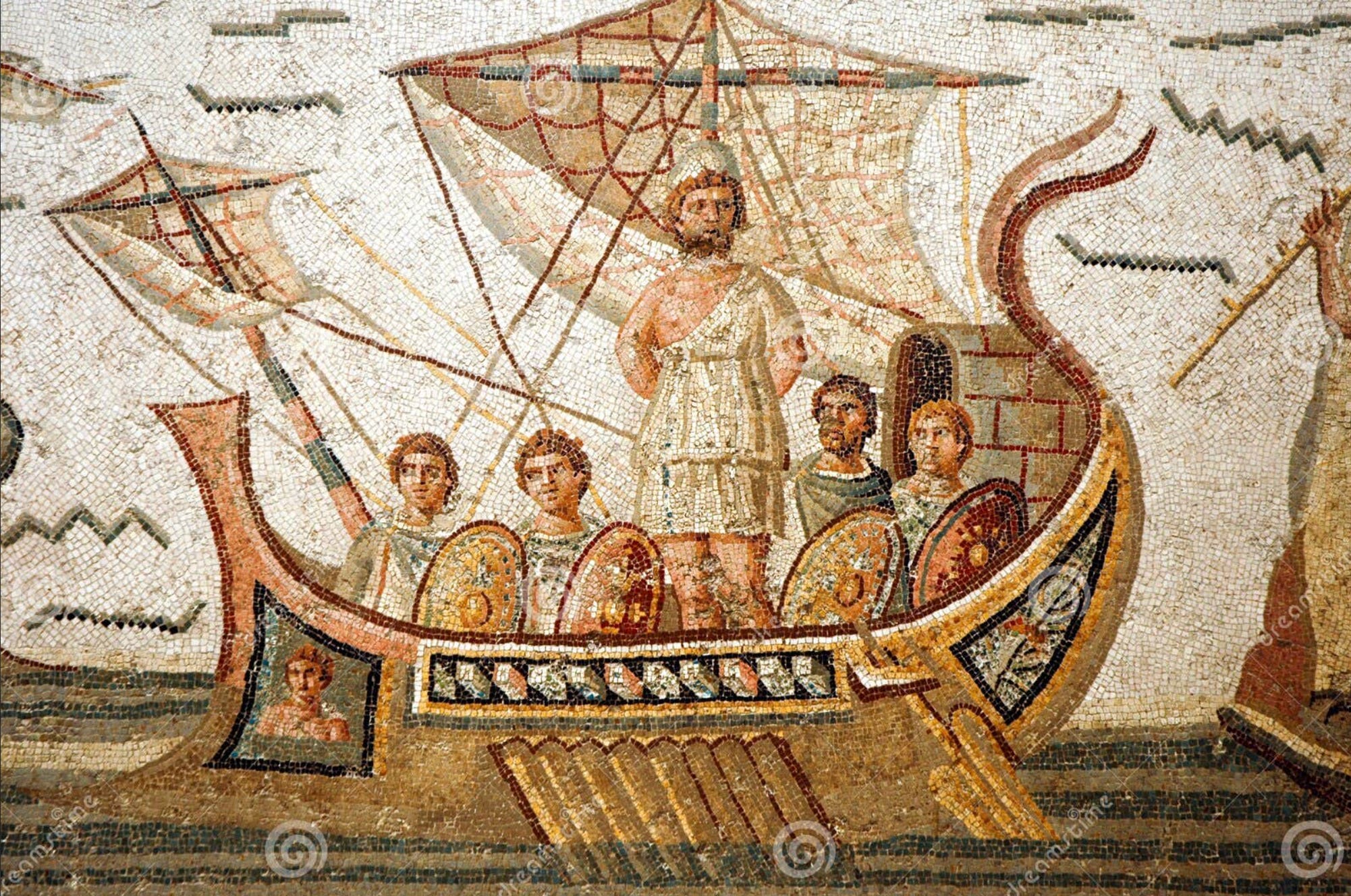
Most recently—devoured in a day—I returned to The Odyssey. Reading The Odyssey in Jerusalem at a time of war was much more powerful than I had anticipated.
I cannot see the Mediterranean from my landlocked balcony. In one direction, Jordan comes into view, but in another, it wouldn’t take long to reach that same sea across which Odysseus wandered—moving from island to island, from trap to escape, from danger to cunning survival—plotting and enduring until he reached his final destination.
Reading The Odyssey in Jerusalem means thinking about ancient peoples and the long arc between war and return, and about what it takes to come back home, not just geographically, but as part of a journey through the straits and shadows of war that feels never-ending.
Two things struck me most.
First: I’m grateful I didn’t start with The Iliad and the Trojan War. I’m glad I didn’t begin with war at all. The Odyssey had no choice, it’s narrative emerging definitively from bloodshed. But here in Jerusalem, amid war in Gaza and Lebanon and facing the looming tension of Iran, I do not seek nor take pleasure in war stories. There are too many. I’ve already heard enough, and I know—sadly—that there will be more.
Like Odysseus himself, I want a story that takes me away from the fight. And yet The Odyssey is, in its way, the story of a warrior who cannot stop fighting, a man who has escaped one set of battles, triumphant on the surface, only to find himself trapped in the long, bewildering journey homeward that includes fighting with himself.
Odysseus says all he wants is to be reunited with his wife, his son, his life. But does he? If so, why does it take so long? What does war do to the idea of home that makes return so difficult, so delayed, so uncertain?
I find myself lingering with that question. I wonder if an entire nation is lingering with that question too.
The second thing that most struck me reading The Odyssey in Jerusalem is the way the rich mythic map of gods and heroes charts the porous boundary between the human and the divine.
Consider the role of grey-eyed Pallas Athena, always my favorite god or goddess—in no small part because I first read this story when The Who’s song “Athena” was released. She appears again and again, not as a distant deity, but embodied. And those eyes. I’ll always have a crush on Athena, just like Pete Townshend did:
Athena, I had no idea how much I need her
My life has been so settled and she is the reason
Just one word from her and my troubles are long gone
But I get along
She's just a girl, she's a bomb
The goddess enters the world as a mentor, and as Mentor himself, but also as a beggar, a fighter, a seeker—a changing voice within a conversation of many, but always behind the blue eyes of someone real. Again and again, divine consciousness merges, if only for a moment, with human speech in a way that makes it simply impossible to know who is actually speaking.
On the one hand, these conversations are not abstract. They are intimate, face to face. But they are also fluid, as something passes between decision and fate, between free will and destiny. But what is it? What does Athena have to offer beyond intervening in fate when deus ex machina is critical? Always, words.
These characters talk and talk. They narrate. They pontificate. For thousands of lines they recount what has happened, how they’ve suffered, and what they hope for. The language is expansive. It rises and falls like the sea itself.
And yet, as Erich Auerbach teaches in “Odysseus’ Scar,” my favorite academic essay of all time, there is something hidden beneath that expansiveness. Writing from Istanbul in the 1940s, having been exiled by the Nazis, Auerbach describes the Homeric style as one that reveals everything on the surface, fully illuminated and richly detailed, while somehow holding back deepest interiority.
The language is expansive. It rises and falls like the sea itself.
We watch the minute detail of the slow reveal of Odysseus’ singular bodily sign that affirms that he is, in fact, who he is hiding, and that his return home is finally complete. Nothing is left unsaid, yet something is unspoken.
Auerbach contrasts this with the biblical style, particularly the story from the Book of Genesis in which Abraham and Isaac walk together up Mount Moriah. So few words are spoken, and here silence is meaning itself. The gaps are where the emotion lives. This effect is almost unbearable, the gravity of what a father is prepared to do to a son so heavy that the text can barely lift itself.
Reading The Odyssey in Jerusalem, I am enmeshed in both of these traditions, caught between saying too much and saying too little—between the need to narrate everything, to speak it all out loud, and the equally powerful need to fall silent, because the truth is too deep for words.
I don’t think I get to choose between these two ways of living within life and myth. Maybe this is the blessing of the reasonably well-read, somewhat believing, partly Hellenistic Jew reading The Odyssey in Jerusalem: to live in that tension.
As Philip Roth suggested, there comes a moment when the task is not to produce something new, but to put down the pen and rest one’s head on words that have carried generations. It was hard and beautiful then. It is hard and beautiful now. But the words remain, worn smooth by sea and sand under the gaze of ever-watchful Athena, ever welcoming us home.